
With each Centerline we provide you with the latest news about upcoming events, news and relevant research findings from our team and affiliated institutions.
Insights from Mapping Electrification of Existing Commercial & Multifamily Buildings
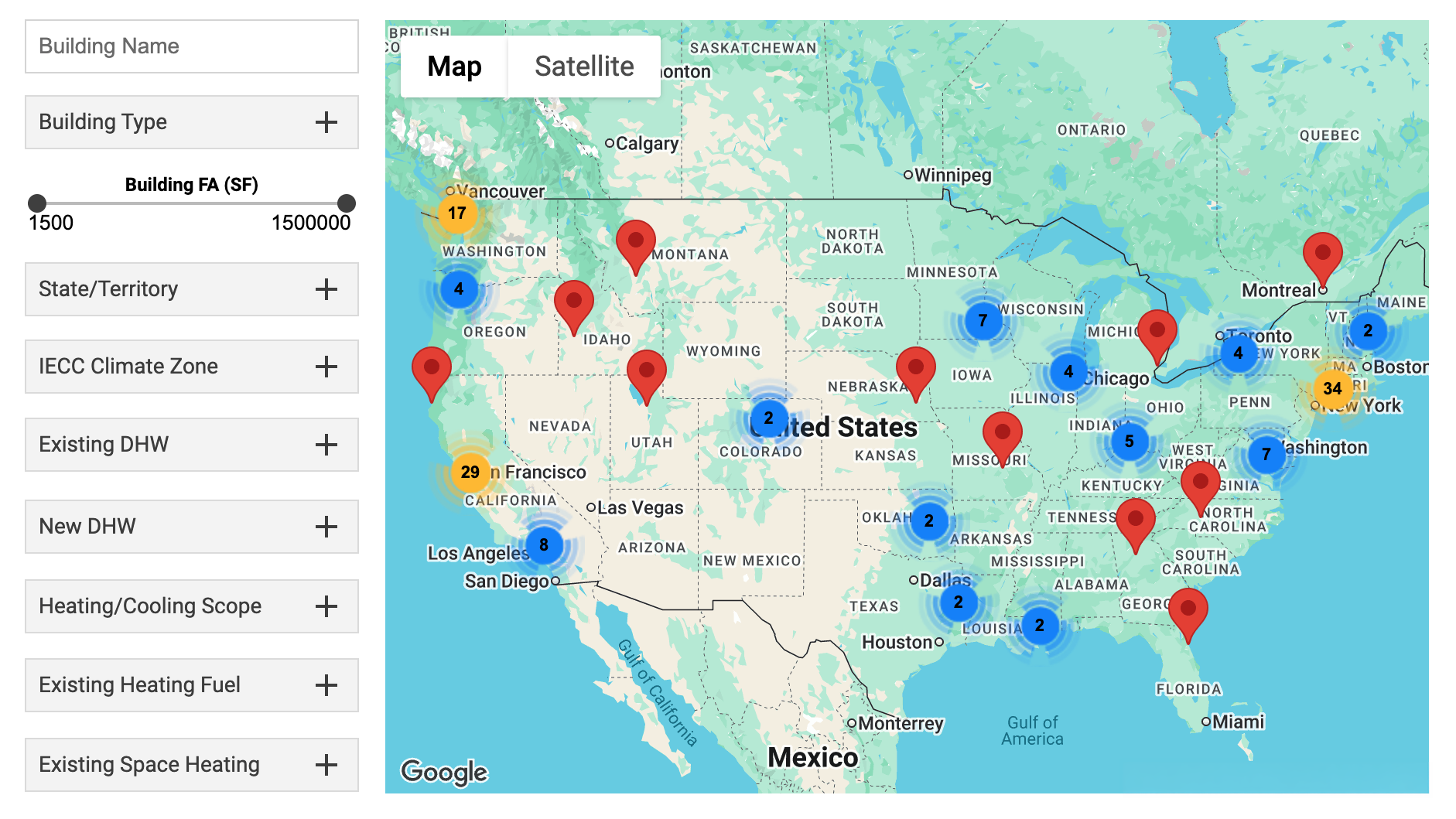
 CBE published findings in the August ASHRAE Journal from a study documenting 142 electrification retrofits across 39 U.S. states and Canadian territories. Unlike new construction, retrofits require navigating existing conditions and constraints. The research identified common drivers — primarily public and private mandates plus government and utility incentives — and barriers to electrification. Successful projects typically have an internal champion and rely on outside incentives. The team compiled the dataset into an open-access map offering examples across a wide range of project types, climates, and building typologies. See the article or open access version.
Emerging Research Leaders Broaden CBE’s Capabilities
 Three new postdoctoral researchers joined CBE this year, bringing extraordinary skills and expanding our research capabilities. Martín Torres joined CBE earlier this year, and has a focus on advanced embodied carbon accounting methodologies, life cycle assessment, and decarbonizing building materials. Chai Yoon Um completed her PhD here this summer and will work on indoor air quality projects, providing scientific knowledge to better control indoor pollutants and reduce occupant exposure. Junmeng (Patrick) Lyu is studying user-centered environmental control, human behavior, and multi-sensor networks for energy-efficient building operation, and is supporting a lab study on view quality. We look forward to the many contributions of these rising research leaders to our work and beyond.
CBE Study Wins Best Paper at ACM SocialSys’26

Our study on using large language models to analyze free-text comments in building occupant surveys won Best Paper at ACM SocialSys’26. Post-occupancy surveys collect thousands of comments about noise, temperature, and air quality—but analyzing them manually isn’t feasible. We tested privacy-preserving LLMs on over 6,000 responses from the CBE Occupant Survey database. Key findings: model size matters (only a 27-billion-parameter model matched human coders), and comments reveal different insights than satisfaction ratings. Scores alone miss what actually bothers people—both need to be read together. The work was led by Thomas Parkinson at the University of Sydney with collaborators from NUS, UC Berkeley, and SMU. Read the paper or learn about the CBE Occupant Survey.
Upcoming Events
We host and support numerous in-person and virtual educational and outreach events each year. Our researchers, faculty, graduate students are also frequent presenters helping to get our research findings in practice, often in collaboration with Industry Partners.
Insights on Zero Carbon Design San Francisco, October 14

Event Banner: Insights on Zero Carbon Design
CBE is supporting a public workshop on zero carbon design with AIA San Francisco, immediately preceding our Industry Advisory Board meeting. This afternoon session features two expert panels: The first explores material durability, recyclability, and whole-life embodied carbon reduction through practical detailing strategies and life-cycle assessment methodologies. The second panel presents case studies including an all-electric affordable housing project built with modular technology and a county office building integrating renewable energy, battery storage and microgrid controls. The session, sponsored by Rockwool, will be followed by a networking happy hour and qualifies for 2 LUs (AIA HSW and California ZNCD). Read more and register.
CBE and Partners Present at ASHRAE Building Decarbonization Conference, Seattle, September 23–25
CBE researchers will present alongside industry partners at the ASHRAE Building Decarbonization Conference in Seattle. Sessions include Seminar 14, “The Cool Kids of Decarbonization,” that will explore creative thermal systems — exhaust air heat recovery, thermal energy storage, and geothermal — plus incentives that make them pencil. Seminar 19, “Decarbonization Tools, Costs and Case Studies,” introduces public resources and empirical data to support electrification strategies in existing buildings. Presenters and moderators include Colin Schless and Andrew Koffke of Turner Construction, Victor Braciszewski and Stet Sanborn of SmithGroup, Curtis Fong of Taylor Engineering, Jacob Goldman of Energy Tax Savers and CBE’s Paul Rafferty.
How Low Can You Go? Refrigerant Limbo at ET Summit, Davis, CA, October 20–21
Low-GWP refrigerants are reshaping HVAC and refrigeration, but navigating evolving technologies, regulations, and market adoption presents challenges. CBE’s Paul Raftery will be a speaker at the ET Summit, on a panel that will explore the latest research, decision-support tools, policy developments, and real-world deployment of low- and ultra-low-GWP refrigerants, including natural refrigerants. Other panelists include Danielle Wright (NASRC), Reginald Wilkins (Southern California Edison), and moderator Ram Narayanamurthy (CEC). See the session details or the full conference information.
Other News and Publications
Below we feature relevant news and publications by CBE researchers, faculty, graduate students and research affiliates.
Analysis Exposes Dangerous Heat Levels in Florida Prisons
A study by Professor Stefano Schiavon found temperatures inside a Miami-area prison routinely reach dangerous levels for extended periods. Commissioned by the Florida Justice Institute, the report supports a class-action lawsuit arguing that excessive heat violates the Eighth Amendment’s prohibition against cruel and unusual punishment. After collecting data during summer 2025, Schiavon found the indoor heat index exceeded 88°F — a threshold linked to heat-related illness — for 97% of the time, frequently rising close to or above 100°F. The suit seeks to require the Florida Department of Corrections to maintain the indoor heat index below 88°F. Read more in the Berkeley CED News or the Miami Herald.
Berkeley Architecture Seeks Assistant Professor in Computation
The Department of Architecture at UC Berkeley is hiring a full-time tenure-track Assistant Professor in Computation and Design Methods. The position seeks candidates whose work applies computation as a creative, social, and technical force in architectural design—connecting systems, tools, and intelligent environments to questions of authorship, agency, governance, and participation. Focus areas may include building information modeling, digital twins, human-building interaction, platform studies, and built-environment science and technology studies. Read more.
Can Evaporative Coolers Create Thermal Refuges During Heatwaves?
Heatwaves are becoming longer, more frequent, and more intense. Air conditioning protects people from extreme heat but strains power grids and remains inaccessible to much of the world. A recent study investigated whether portable evaporative coolers could create thermal refuge areas during hot, dry heatwaves. We tested a 220W whole-room evaporative cooler and a ~10W personal unit using a thermal manikin. The whole-room cooler reduced air temperature by up to 2.8°C (5°F) and produced an average 3°C (~5°F) cooling effect on the body. Combined with the personal cooler, this increased to approximately 6°C (~11°F). Results suggest portable evaporative coolers could provide fast-acting, low-energy cooling where air conditioning is unavailable. Read the LinkedIn summary or the full paper.
Study of Dynamic Bedroom Cooling Reveals Challenges
Lab studies suggest dynamic bedroom temperature control can improve sleep, and many air conditioners now offer “sleep modes.” But does this work in real homes? We tested this in 18 study participants’ own bedrooms, monitoring each for at least 30 nights. We found that reproducing intended temperature profiles outside the lab proved difficult — only 44% of dynamic nights met our criteria. When the implementation quality was low, some sleep outcomes were actually worse than with constant setpoints. One key takeaway is that before applying predefined dynamic temperature profiles, we need to understand how each bedroom responds to air conditioning. Access the paper or this free access version (50 days).