
| General Information |
| Location |
 |
Santa Barbara, CA |
| Owner |
|
University of California, Santa Barbara |
| Architect |
|
Zimmer Gunsul Frasca Partnership |
| Engineer |
|
Mechanical - Flack & Kurtz
Structural - KPFF
Civil - Penfield & Smith |
| Completed |
|
January 2002 |
| Building Use |
|
Academic, Assembly |
| Size |
|
84,672 SF |
| Stories |
|
Four |
| Cost |
|
$22,000,000 |
| Occupancy |
|
239 |
| Relevant codes |
|
UBC |
|
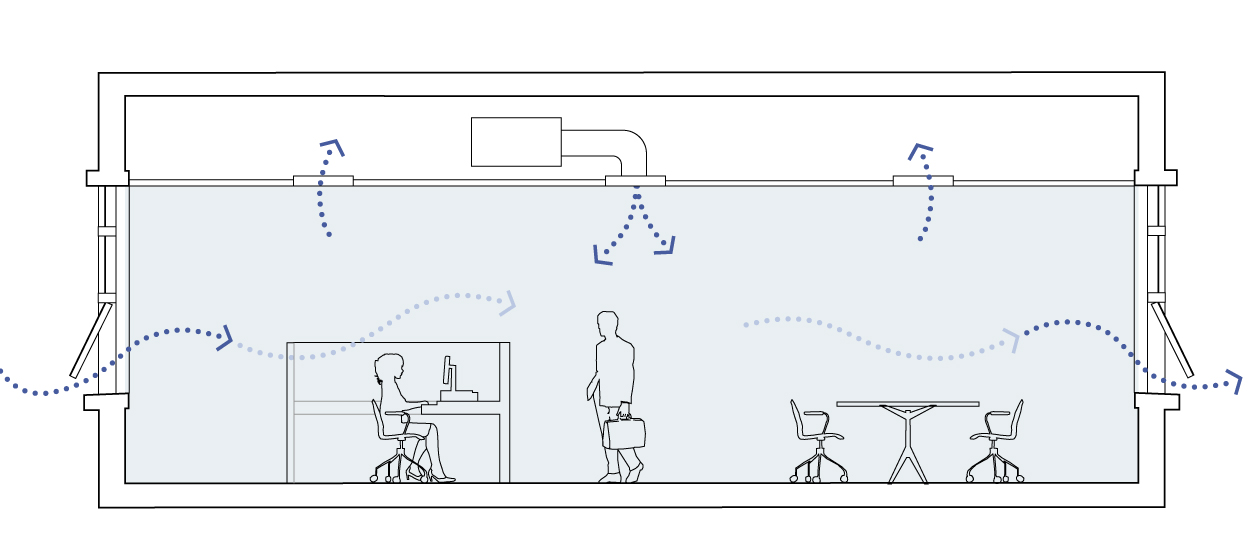
Mixed Mode System |
| Mixed Mode Strategy |
|
Bren Hall uses a concurrent system;
laboratories and rooms at the building core are air conditioned while
offices and other perimeter spaces are naturally ventilated. The building
is formed from two wings, one primarily of offices and one primarily
of laboratories, that create an exterior courtyard between them. There
are two subgroups of naturally ventilated spaces: rooms in the four-story
office wing that were explicitly designed to be naturally ventilated
and rooms on the fourth floor of the laboratory wing that were added
into the design at the last minute. The laboratory building was originally
scheduled to be three floors; the Chancellor added a fourth floor, out
of a separate budget, late in the design process in order to provide
surge space for different departments around campus. |
| Natural Ventilation Details |
|
Offices have operable windows and transoms
with a mechanical interlock – a small sensor on the window frame – that
turns off the heating system when the windows are open. The office wing
is single loaded; all offices open to the central courtyard and have
fenestration on at least two sides of the space. Though the windows and
transoms are typically adequate, the doors can also be left open to increase
ventilation. Though windows and transoms have sensors, the doors do not.
Because of the timing and the nature of the fourth floor addition project,
it was developed in a differently from the rest of Bren Hall; little attention
was paid to the design of the natural ventilation system. Unlike rooms
in the office wing, the design team did no flow modeling or calculations.
The lesson from this project is simple: when designed for natural ventilation,
with appropriate modeling and calculations, spaces are much more likely
to be comfortable. A good climate and prevailing wind direction are not
adequate to ensure successful naturally ventilated spaces.
As a rule, offices built today at the University of California Santa Barbara
are naturally ventilated; though operable windows were the standard for
offices on the UCSB campus, the mechanical interlock was unusual there
when added to the project. |
| HVAC System Details |
|
Though not a fumehood intensive building,
safety restrictions on air control in the laboratories prohibits natural
ventilation. The laboratories and other mechanically cooled spaces are
connected to UCSB’s multi-building chilled water loop. This is
a more cost-effective and energy efficient way to mechanically cool buildings
than stand-alone systems. Bren Hall has its own chiller, which can pick
up additional campus load when necessary. The University estimates that
the savings from linking the Bren Hall chiller into the campus system
is 85% of its run time. The cooling tower’s drift eliminators are
designed to recapture and recirculate water lost through evaporation.
The system also includes a variable air volume (VAV) system in the laboratory
wing and three exhaust towers with different sized fans. These components
all function on demand, minimizing mechanical system run time when not
needed. Air intakes are located at a different part of the building than
the exhaust.
The boiler is 85% efficient. |
| Configuration & Control |
|
The building contains an extensive control
and metering system. The building has a permanent air monitoring system
with automatic controls on heating and air flow to ensure maximum air
quality with minimum energy use. The system monitors for carbon dioxide,
carbon monoxide and particulates.
A measurement and verification protocol was designed by EASI Consulting.
The building has 13 meters, including those for chiller, boiler, lighting,
reclaimed water, potable water; web interface control systems monitor many
of these. The information from this system has been used in the design
of other buildings on campus.
UCSB has a building engineer and a campus energy manager to oversee the
configuration, control, metering and general operation of the Bren Hall. |
| Building Design Process |
| Time Line |
|
1992-2002
Green building was not a goal for Bren Hall when plans for the project
commenced in 1992 nor when funding became available in 1997. When the
Bren Hall Advisory Board began meeting in 1998, it set environmental
issues as a priority for the project, intending it to be a tool for
implementing policy change and a model facility for future buildings
at UCSB, at other UC campuses and throughout the state of California.
At this time, the school funded “The Greening of Bren Hall: Sustainability
Design Feasibility Study,” released in 1999. The project team
learned about the LEED Rating System in 1998, but was uncertain if
the project would have the additional funding to move forward with
a LEED rating. A number of features in the original building design
would guarantee LEED credits, but the team put out additional elements
as add/alternate measures to the base bid. The operable windows with
mechanical interlock were included as an add/alternate with a price
tag of $26,901. |
| Design Tools |
|
The project team used the U.S. Green
Building Council's LEED Rating System for setting goals in the building
design beginning in 1998. |
| Energy Analysis |
|
DOE-2 software was used for energy
analysis. Energy modeling expected the building to surpass Title 24 by
30%. These savings are generated through a combination of efficient mechanical
systems, natural ventilation and an integrated daylighting/electric lighting
plan, among other things. |
| Commissioning |
|
Bren Hall was the first building on
the UCSB campus to be fully commissioned, with services provided by EASI
Consulting. Campus staff have used their experiences on this project
to develop an in-house campus commissioning program for future construction
projects. |
| Building Performance |
| Outdoor Air/Noise |
|
The building is located adjacent to
the ocean; the predominant breezes blow from that direction. As a result,
the outdoor air is typically clean and cool. There is very little outdoor
noise that is not generated from building activity, though some noise
that is generated by the building’s courtyard. Casual noise from
conversation in the courtyard is not considered to be a problem by professors
with offices – and operable windows and transoms – adjacent
to this space. |
| Occupant Satisfaction |
|
The University of California Berkeley
Center for the Built Environment is in the process of performing a web-based
occupant Indoor environmental quality (IEQ) survey at Bren Hall. The
survey will address general building satisfaction, general workspace
satisfaction, office layout, office furnishings, thermal comfort, air
quality, lighting, acoustic quality and cleanliness and maintenance.
Within the first year and a half of operation, there were very few complaints
about conditions associated with the mixed mode system in the spaces explicitly
designed for it. The fourth floor of the laboratory wing, however, has
been extremely uncomfortable for occupants, reaching into the 90 and 100
degree range during the summer. Because this floor is used as a surge space,
however, no department is there for very long and none wants to pay to
install mechanical cooling. The problem is so severe, however, that departments
are reticent to locate there, even temporarily.
The Dean’s conference room is a double loaded naturally ventilated
space that does become uncomfortably warm, but only a few days a year;
occupants can open both doors to resolve the issue. |
| Actual Energy Data |
|
144.7 kBtu/sf/yr
The design team estimated that Bren Hall would surpass Title 24 requirements
by 30%; the actual savings is 32.8%. |
| Additional Building Features |
| Sustainable Sites |
|
• Built on the site of
a former parking lot.
•
Construction footprint minimized to preserve existing natural conditions,
including the preservation of trees on site.
•
Small plants removed were made into mulch for use on other parts of the
campus.
•
Erosion and sedimentation were prevented during construction with hay bales,
fencing and desilting facilities at each drainage outlet.
•
Native soil removed during construction was held and reintegrated into
the landscape plan.
•
Energy star cool roof is highly reflective to reduce solar heat gain
•
Stormwater management plan to control the water that enters the adjacent
ocean and other waterways.
•
Permeable pavers at the bike parking area and permeable turf block with
grass overlay at the fire road that loops the building. |
| Water Efficiency |
|
• Waterless urinals
•
Automatic flush valves on toilets
•
Automatic water sensors on sinks and low flow fixtures throughout the building.
•
Toilets on the first floor are connected to the municipal graywater system.
•
Drought tolerant native plants
•
Municipal graywater for irrigation. |
| Energy and Atmosphere |
|
• Daylighting displaces
the need for some artificial lighting.
•
Energy efficient electric fixtures and bulbs
•
Motion and ambient light sensors to reduce energy use.
•
The landscaping was designed to help to shade the building.
•
240 42-kilowatt photovoltaic panels on the roof of generates 7-10% of its
electricity demand.
•
Grid power from landfill methane gas provides 25% of the building’s
electricity. |
| Materials and Resources |
|
• 100% of demolition waste
and 92% of construction waste was recycled or reused.
•
24% (by cost) of materials contain a minimum of 20% post-consumer or 40%
post-industrial recycled content, including carpets, lab casework, rubber
flooring, fabrics, wallboard, tiles, ceiling tiles and grids, furniture,
countertops, insulation, restroom partitions, fireproofing, steel, tree
bases and fly ash in concrete.
•
Concrete included 20% fly ash in the first two floors and 17% in the upper
two floors.
•
Structural steel and rebar contain 80-100% recycled content and the pan
deck contains 30% recycled content.
•
Carpet tiles are cleaned and re-dyed.
•
Wood paneling and cork flooring originated in sustainably harvested forests
•
Rapidly renewable linoleum is one of the primary flooring materials in
the project.
•
Local materials specified to come from within a 350-mile radius of the
site. |
| Indoor Environmental Quality |
|
• Paints, adhesives and
finishes exceed the 2005 South Coast Air Quality Standards
•
Building had an IAQ construction management plan to sequence product installation
for the reduction of VOC sinks and a one-week flush-out prior to occupancy.
•
Building contains no asbestos, formaldehyde or CFC’s. |
| Project Team |
| Architect |
|
Zimmer Gunsul Frasca Partnership
515 South Flower Street, Suite 3700
Los Angeles, California 90071
213.617.1901
http://www.zgf.com |
| Mechanical Engineer |
|
Flack & Kurtz
405 Howard Street, Suite 500
San Francisco, CA 94105
415.398.3833
http://www.flackandkurtz.com |
| Civil Engineer |
|
Penfield & Smith
101 East Victoria Street
Santa Barbara, CA 93101
805.963.9532
http://www.penfieldsmith.com
|
| Structural Engineer |
|
KPFF Consulting Engineers
Structural Division - Pasadena
Attn: Aldrin J. Orue,
2 North Lake Avenue, Suite 820
Pasadena, CA 91101
626.578.1121
http://www.kpff-pas.com/proj_en6.html |
| Landscape Architect |
|
Wallace Roberts & Todd
1133 Columbia St., Suite 205
San Diego, CA 92101
619.696.9303
http://www.wrtdesign.com |
| Laboratory Consultant |
|
Earl Walls Associates
5348 Carroll Canyon Road
San Diego, CA 92121
858.457.2400
http://www.ewalab.com |
| Contractor |
|
Soltek Pacific
2424 Congress Street
San Diego, CA 92110
619.296.6247
http://www.soltekpacific.com |
| Acoustics Consultant |
|
McKay Conant Brook, Inc.
5655 Lindero Canyon Road Suite 325
Westlake Village, Ca 91362
818.991.9300
http://www.mcbinc.com |
| Additional Information |
| Awards |
|
• USGBC LEED 1.0 Platinum
Rating, April 2002
• Flex Your Power Energy Efficiency Award, February 2004
• International Interior Design Association Environmental Award, May 2003
• Parade of Green Buildings featured site, April 2003
• Goleta Valley Beautiful Award, November 2002
• Commendation from former California Governor Gray Davis, 2002
• Commendation from the County of Santa Barbara, 2002
• Case Study for the California Energy Commission
• Case Study for the California State and Consumer Services Agency |
| Sources |
|
• Donald Bren Hall website
http://www.bren.ucsb.edu/about/donald_bren_hall.html
• Greener Buildings case study
http://www.greenerbuildings.com/case_studies_detail.cfm?LinkAdvID=52746
• California Integrated Waste Management Board case study
http://www.ciwmb.ca.gov/GreenBuilding/CaseStudies/Educational/BrenLEEDCost.pdf |
| Contact |
|
Primary Contact
Perrin Pellegrin
Campus Sustainability Coordinator
UC Santa Barbara
(805) 893-2661 ext. 2208
perrin.pellegrin@dcs.ucsb.edu |