
| General Information |
| Location |
 |
Menlo Park, CA |
| Owner |
|
The William and Flora Hewlett Foundation |
| Architect |
|
B. H. Bocook, Architects, Inc. |
| Engineer |
|
Critchfield Mechanical, Inc. |
| Completed |
|
May 2002 |
| Building Use |
|
Commercial Office |
| Size |
|
48,000 square feet |
| Stories |
|
Two |
| Cost |
|
Unknown |
| Occupancy |
|
Unknown |
| Relevant codes |
|
California Building Code |
| California Climate Zone |
|
3 |
|
Mixed Mode System |
| Mixed Mode Strategy |
|
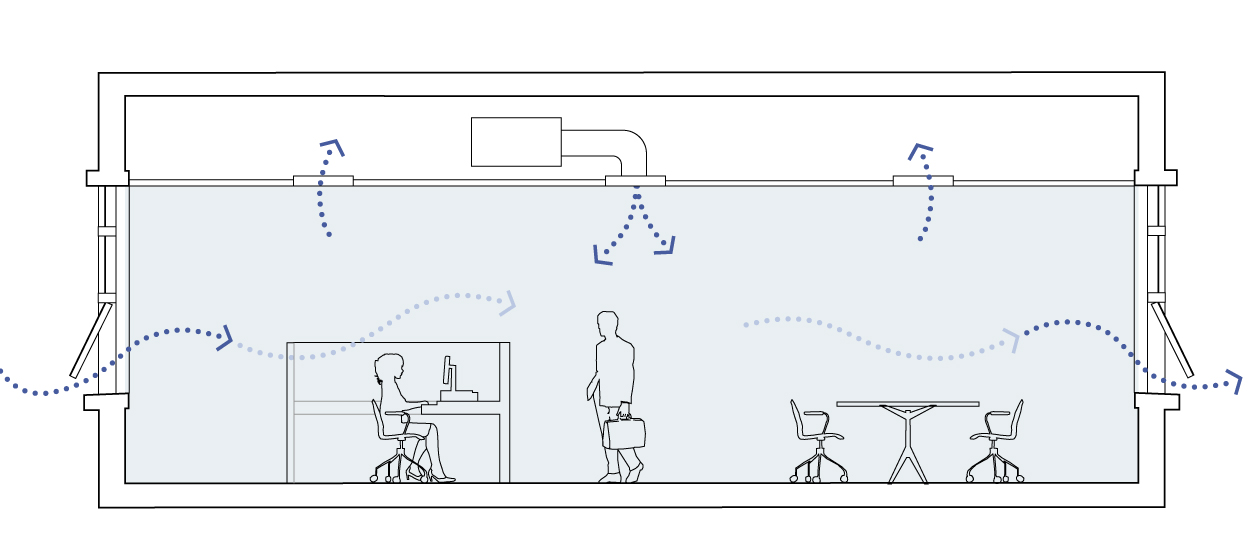
The Hewlett Foundation building used a
changeover system where the windows and mechanical cooling operate at different
times. The operable windows are considered as part of the building mechanical
system’s economizer cycle. |
| Natural Ventilation Details |
|
At the occupied level, the building has
crank-operated, casement type operable windows set adjacent to fixed vision
glazing, and are provided in all exterior offices. A 12-inch maximum opening
governor is installed on all the first floor operable windows for security.
When the economizer cycle is initiated mechanical operators open awning
windows in one panel of each of the three upper clerestory bays utilizing
the stack effect to exhaust air from the building. |
| HVAC System Details |
|
An underfloor air distribution system provides
fresh conditioned air closer to the occupied level via manually operated
floor diffusers, and then removes warm polluted air via return air and
exhaust devices placed in the ceilings. An evaporative cooling chiller
is used in concert with an ice storage system, creating ice during off-peak
hours at night and using it to cool the building during the day, thus minimizing
the need for energy during peak demand periods. Two air handlers located
in the basement parking area provide ventilation through a raised floor
system with an air highway. Heating is provided by a high efficiency boiler
with heating coils in the exterior zones located in the raised floor. None
of the systems use ozone-depleting chlorofluorocarbons. |
| Configuration & Control |
|
The building management system is used
to determine when the ventilation system should switch into natural ventilation
(economizer) mode. The changeover occurs when sensors determine that the
return air is warmer than the outside air and the outside air is between
50 and 78 degrees Fahrenheit. When this condition occurs, the cooling system
shuts down, the clerestory windows are mechanically opened and small lights
in the corridors change from red to green indicating to the occupants that
it is acceptable to open windows. This form of “informational control” allows
the building to balance the needs for comfort and energy efficiency. |
| Building Design Process |
| Time Line |
|
2000-2002 |
| Design Tools |
|
The U.S. Green Building Council’s
LEED Rating System was used in setting the goals for the project before
the design began. |
| Energy Analysis |
|
Carrier HAP modeling was used to determine
the ice cooling needs by simulating a one week period in a typical summer. |
| Commissioning |
|
Comprehensive building commissioning included
design review, installation testing, and continuous measurement and verification
of the overall system and individual devices. All of the building systems
were meticulously tested upon installation and will be routinely monitored
to ensure high performance over time. The commissioning process did not
result in any major changes in the building’s ventilation design.
The commissioning design review did identify the need to add an additional
control sequence to the ice storage system to allow for simultaneous ice
making and use in the event of the building being occupied on a warm evening. |
| Code Conflicts |
|
There were no code conflicts with the mechanical
and natural ventilation strategies. At the time of design review the owner
did decide to add an additional ice storage unit to increase the capacity
to cool the building as a precaution but this was not due to any code requirements. |
| Other Design Issues |
|
The design team had some difficulty determining
an appropriate release exhaust vent location for the building due to the
sloped roof. Ultimately the mechanical exhausts were located next to the
stair and elevator towers. |
| Building Performance |
| Outdoor Air/Noise |
|
The building is located next to a heavily
trafficked street but is set back far enough from it and buffered by vegetation
to mitigate any noise or air quality concerns. Greater concern was actually
based on the fear that the building itself could become a noise nuisance
for the adjacent residential areas. |
| Occupant Satisfaction |
|
The University of California Berkeley Center
for the Built Environment administered a web-based Occupant Indoor Environmental
Quality (IEQ) survey at the Center for Global Ecology. The survey addressed
general building satisfaction, general workspace satisfaction, office layout,
office furnishings, thermal comfort, air quality, lighting, acoustic quality
and cleanliness and maintenance. Survey results are currently being analyzed
and will be posted at a later date. |
| Actual Energy Data |
|
In progress. |
| Additional Building Features |
| Sustainable Sites |
|
• The site is in proximity to alternative
transportation lines, the Stanford University campus, local community infrastructure,
and bike and walking paths.
• Many existing trees, including several magnificent oaks, have been preserved.
• 60% of the site has been dedicated for open space.
• Site drainage and storm water control systems employ bio-swales,
detention ponds, and filtration devices to limit disruption of natural
water flows,
increase on-site infiltration, and eliminate contaminants.
• Exterior lighting has been kept to a minimum in order to protect night
sky visibility and animals’ nocturnal habitats, as well as lessen
the impact on neighbors. |
| Water Efficiency |
|
• Highly efficient irrigation equipment
and drought-tolerant landscaping that features adapted and native vegetation
combine to reduce water consumption by a projected 50% compared to similar,
conventionally landscaped sites.
• Waterless urinals in the men’s restrooms.
• Small, efficient dishwashers in the staff cafes.
• It is estimated that the building consumes 15% less water compared to similar
facilities. |
| Energy and Atmosphere |
|
• Innovative systems include underfloor
air distribution, evaporative chillers, and ice storage.
• Ample daylight reduces the use of energy for lighting and contributes to
an open interior atmosphere.
• Spectrally selective window glazing.
• Motion sensors shut down unnecessary lights when rooms are unoccupied.
• Photovoltaic panels on the roof.
• Building exceeds the already stringent California Title 24 energy efficiency
standards by an estimated 35%. |
| Materials and Resources |
|
• Building materials consist of 64%
percent recycled content.
• A third of the materials were manufactured within 500 miles of the site.
• More than 83%of all the wood-based products are certified.
• Building materials were further evaluated on the basis of performance,
low embodied energy values, and their potential to be diverted from landfills
at the end of their usable life.
• Nearly 70% of construction and demolition waste was diverted from landfill
to recycling or salvaging operations.
• Convenient bins throughout the building facilitate recycling of paper,
plastics, and other materials by staff and guests. |
| Indoor Environmental Quality |
|
• Low-emitting materials including
carpet, paint, composite woods, adhesives, and sealants, minimize the introduction
of potentially hazardous or irritating substances into the building.
• Other potential sources of air quality contaminants, such as workrooms
and janitorial closets, are contained by full height walls, where a negative
pressure is maintained and air is exhausted directly to the outside. |
| Project Team |
| Architect |
|
B. H. Bocook Architects, Inc.
4041 El Camino Way
Palo Alto, CA 94306
650.856.9510
http://www.bocookarchitect.com |
| Interior Design |
|
Hawley Peterson & Snyder Architects
100 View Street, Suite 100
Mountain View, CA 94041
650.968.2944
http://www.hpsarch.com |
| MEP Engineer |
|
C & B Consulting Engineers
Critchfield Mechanical, Inc.
4085 Campbell Ave.
Menlo Park, CA 94025
650.321.7801
http://www.cmihvac.com |
| Electrical Engineer |
|
The Engineering Enterprise |
| Commissioning |
|
CTG Energetics, Inc
16 Technology Drive, Suite 109
Irvine, CA 92618
949.790.0010
http://www.ctg-net.com/energetics/EnergeticsHome.htm |
| Landscape Architect |
|
The Office of Cheryl Barton
65 McCoppin Street
San Francisco, CA 94103
415.551.0090
http://www.toocb.com |
| Leed Coordinator |
|
Simon & Associates
200 Brannan Street
San Francisco, CA 94107
415.908.3757
http://www.greenbuild.com |
| Developer |
|
Ford Land Company
Menlo Park, CA |
| Contractor |
|
Vance Brown Builders
3197 Park Blvd
Palo Alto, CA 94306
650.849.9900
http://www.vancebrown.com |
| Project Manager |
|
Bennington/Conover & Associates
1547 Rainbow Drive
Cupertino, CA 95014
408.255.9155
http://www.benningtonconover.com |
| Additional Information |
| Awards |
|
• U.S. Green Building Council LEED-NC,
v2 Gold (2002). |
| Sources |
|
• The William and Flora Hewlett Foundation
website
http://www.hewlett.org/More/Foundation+Headquarters/
•
Recycleworks website (San Mateo County)
http://www.recycleworks.org/greenbuilding/gbsanmateo.html
|
| Contact |
|
Primary Contact
Kailasam Senthil
Critchfield Mechanical, Inc.
4085 Campbell Ave.
Menlo Park, CA 94025
650.321.7801
http://www.cmihvac.com
|